![]() |
| Sommer 2014 |
![]() |
| Summer 2022 |
![]() |
| Sommer 2014 |
![]() |
| Summer 2022 |
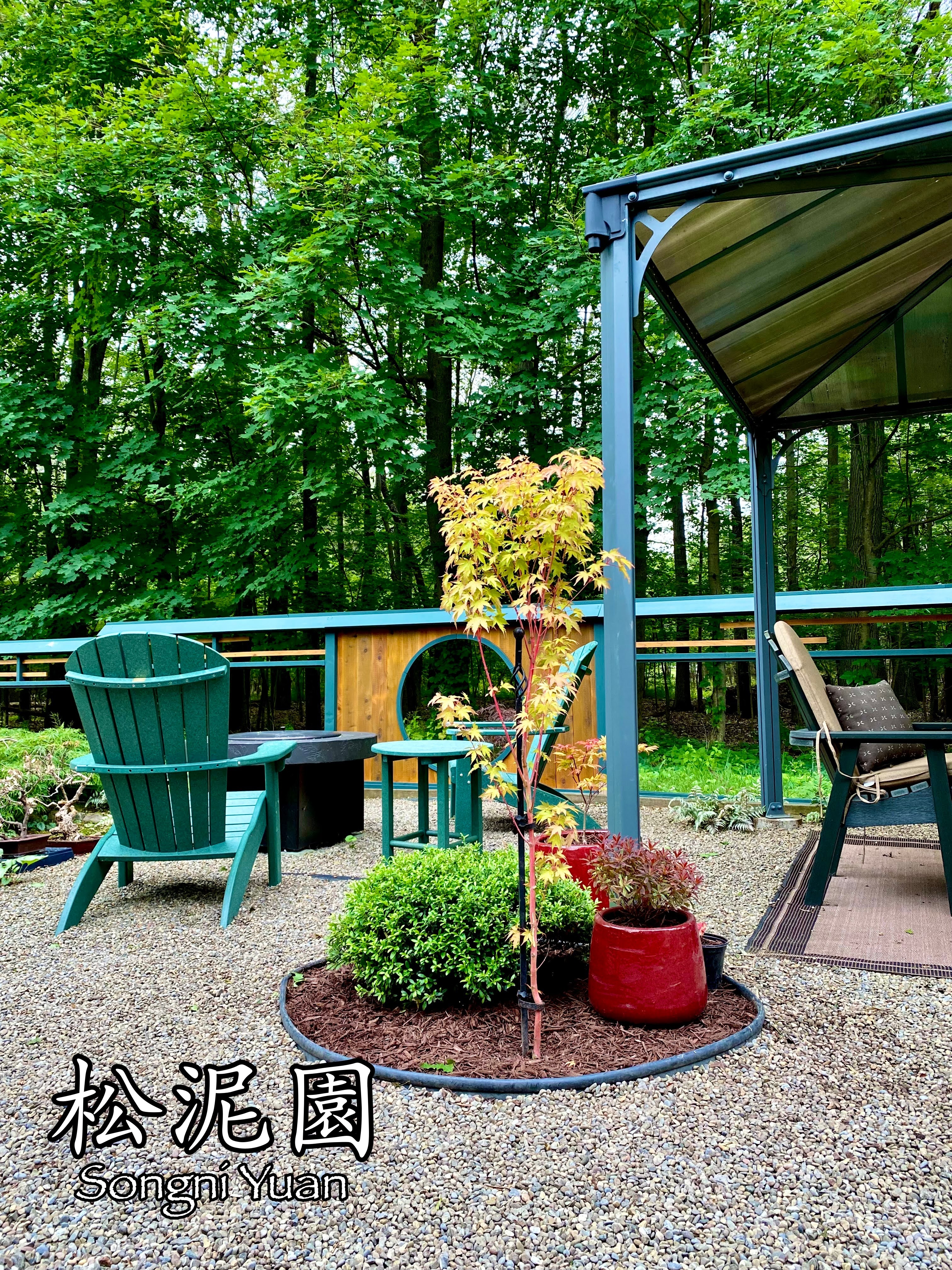
I took the time to plant the Coral Bark Japanese Maple (Acer palmatum 'Sango kaku/coral bark') in front of the gazebo post as planned.
Before doing so, I decided to create a small circular bed lined with plastic trim as a place to plant the tree and place some small assorted plants. The plastic edging will help to keep the peastone out of the area directly around the tree and allow me to amend the soil here from time to time.
The corner post of the gazebo is one of the first things people see when they enter the garden, so I am hoping this Maple will help soften that corner and add some interest to the garden by adding some color and a canopy. This maple has the possibility of growing to 20' x 14', but my plan is to prune it and maintain its growth and shape (I hope).
I was concerned after starting that I was disrupting the Feng Shui of the garden by placing this tree and bed in front of the post. It disrupts the straight path from the back lawn towards the Zen garden.
I'm not sure if I am violating any strict Feng Shui rules, but the idea of having a canopy with some color here and blocking the harsh view of the post, outweighs my concerns about maintaining a straight uninterrupted path. Maybe the bend will impede any "hungry ghosts" who try to enter the garden (they like to travel in straight lines).
Time will tell, as the tree grows, if it was a mistake or not.
For now, I placed the potted Bonfire (Euphorboia epithymoides 'Bonfire') and Autumn Moon Maple (Acer shirasawanum 'Autumn Moon') near or in the bed.
In time, I can also add some small annuals to the bed to add seasonal interest.
With my retirement from teaching fast approaching, a few friends gave me a gift card to a local nursery, and I made full use of the gift card to purchase some new plants for the garden.
With all the fence wok going on, I haven't done much with the garden plants. Especially after the weeks long inundation we suffered from a Spongy Moth invasion (formally known as "Gypsy" Moths). Now that the caterpillars have transitioned to becoming moths, the leaf debris and excrement they left behind is starting to disappear. It will be a couple more weeks before it gets better. The excrement alone did a lot of damage to my Moss areas, and the leaf debris is everywhere. Very unsightly. Without a doubt the worst invasion of caterpillars I have ever seen.
My trampling all over the garden while building the new fence also hasn't helped.
Here are the the plants I purchased:
Now I can start thinking about the new plants, where I will place them, and how to bring the garden back into balance with more beauty.
Pumpkin Spice Foamy Bells (Heusherella x 'Pumpkin Spice')
I love the color of these Foamy Bells, but I honestly have had very little luck with Cora Bells and Foamy Bells over the years. They never seem to last more than one of two seasons. Nevertheless, I thought I would give one another try. This time I will amend the soil and pay more attention to fertilization. I am also hoping the slugs stay away. They don't alway like the prickly nature of the leaves and stems. Hopefully that will be a good deterrent. In the meantime, I will enjoy the color vaiation in the garden for one season (and perhaps many more).
Bonfire (Euphorboia epithymoides 'Bonfire')
Autumn Moon Maple (Acer shirasawanum 'Autumn Moon')
Coral Bark Japanese Maple (Acer palmatum 'Sango kaku/coral bark')
It may take a few days before I get around to planting and potting, but once retirement is official, I will have all the time I need to care for the garden.
- 月亮代表我的心 (The Moon Represents My Heart)
I've been working on repairing and reinstalling the garden fence all spring and into the summer. New posts are in, rails attached, cleats installed for cedar panels, and the decorative parts along the top installed, including the roof sections.
One major repair and renovation was the moon window.
![]() |
| Moon Window 2020 |
I was able to salvage about 95% of the window pieces and only had to replace four small sections that had rotted.
I sanded each piece down and re-stained them.
They have a dark patina due to age and exposure to weather, but I think it makes them look a bit more "ancient."
In order to reuse most of the pieces I simply turned the window upside down. The bottom pieces were often below the snow line, hence the rot, but the top pieces were in great shape since they were mostly covered by a roof. The replaced pieces all came from the bottom.
Since I was working on the re-install during Father's Day, my wife decided to help me.
During the rebuilding of the garden fence, I haven’t had much time to tend to plants. Still, it is impossible to ignore the beauty of the Bugleweed growing in front of Buddha. It’s reaching full bloom this week and the purple color is outstanding.
Unfortunately, the new fence panels won’t be installed until the colorful bloom passes. Hopefully, next year will look as nice with a different backdrop.
I was visiting a local nursery, with no plans to buy, just browse. However, as usual, I could not control myself.
I loved the way that the Crabapple tree I planted in the stroll garden last year had turned out.
It blocks the view of my neighbor's house, made a great transition point between the viewing garden and the stroll garden, and the blossoms this spring were spectacular.
The problem was that at the opposite end of the garden, just behind the small Moon Lantern, there was a void that I felt needed to be filled.
Primarily, the view near and above the fence was characterized by the large Snowmound Spiraea, a telephone pole, and an open view of the neighbors across the street.
I thought having a similar sized tree, but a different variety, would help add some balance to the view.
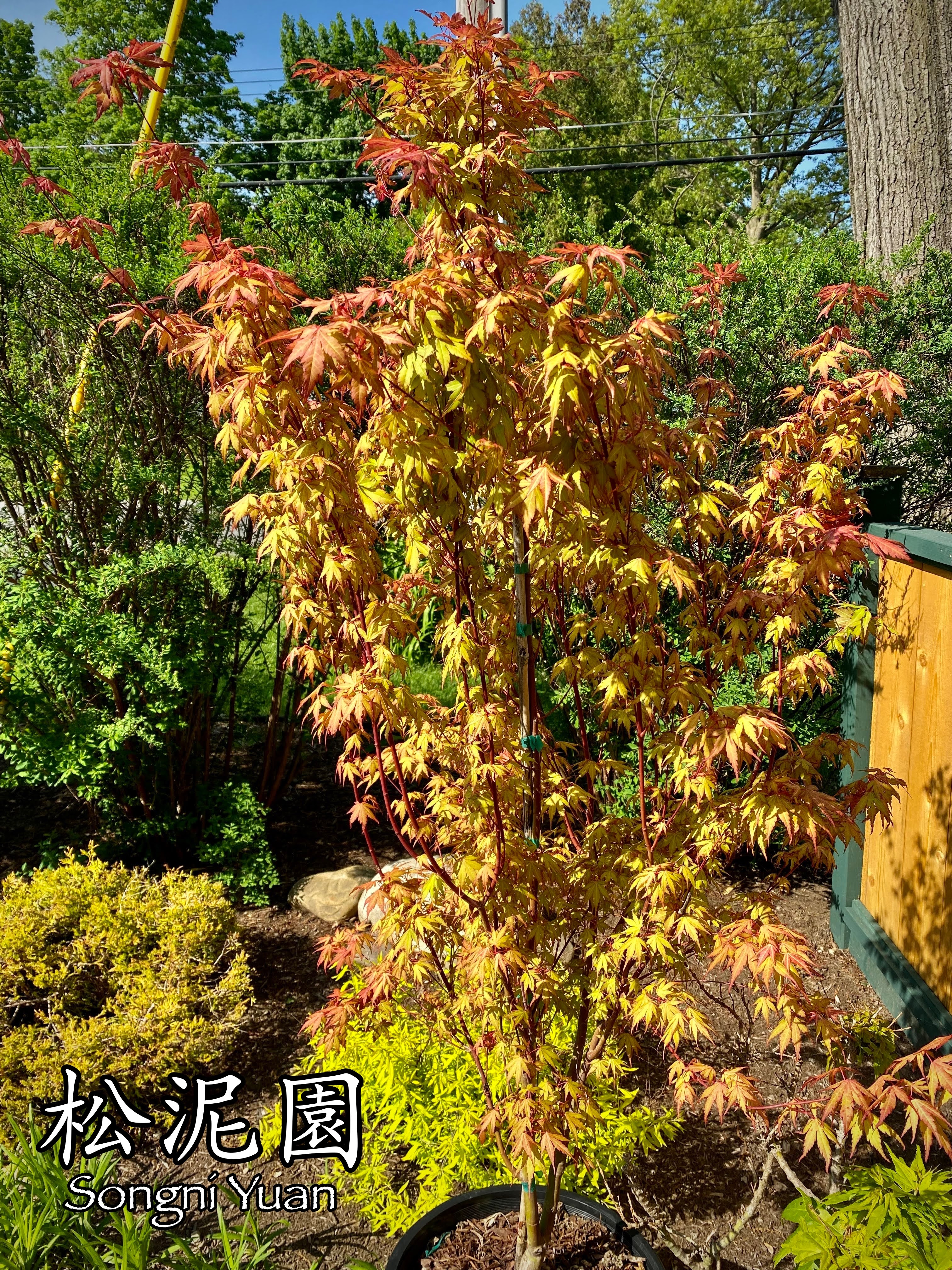
While at the nursery, I stumbled upon a tree that immediately caught my attention. A First Flame Maple "Iseli Introduction" (Acer x pseudosieboldianum).
This maple has star shaped leaves that are a bright red-orange. The colors were more fall-like than spring. Mid-summer, the leaves should turn a light green. However, the red-orange leaves should continue to emerge throughout the summer.
Over time, the tree will grow to 20' H and 15' W, but it can be trimmed as easy as any other Acer type maple tree, like my dwarfs I have elsewhere in the garden.
I also think it will help to distract from the telephone pole as well, and be well centered with the lantern and rock in the viewing area of the garden.
I love the color and think it will make a nice addition to the viewing garden, adding a fall-like interest all summer.
With the arrival of spring and warmer weather, I have been waiting for the Crabapple tree (Mrs. Krabappel) that I planted last year to flower.
As of May 5th, there were no flowers, but the leaves were a nice bright red.
I have been checking daily, as other trees in the neighborhood were blooming all around. I was beginning to wonder if Mrs. Krabappel would even flower this year.
However, this afternoon I discovered the first bloom.
Now I will wait and see what the next few days offer. I'm hoping to see more blooms.
With new fence posts in, it was now time to add fence rails.
One major change I made with this new fence design was to use of OWT Ornamental Wood Ties 2 x 4" Top Rail Saddles. The saddles are powder-coated metal and very solid.
They could be installed at 90 degrees or perpendicular, allowing them to be used for the top rail and the bottom rail design I am employing.
They were easy to install. By placing one end of the 2 x 4 into a saddle while I worked at the other end, it allowed me to install the rails without any human assistance.
They should also reduce a rot issue I encountered with the old fence design. Originally, I attached each rail with two screws from the top. Over a decade, water seeped into the screw holes and compromise the ability of the screws to support the rails, especially along the bottom rails which were often below the snow line in the winter. These saddles should reduce the likelihood of that occurring.
Another change I made was to use two 2 x 4s, one vertical, and the other horizontal, for the bottom rail support (similar to the fence I built last year in the stroll garden).
I did this because this new design will use cedar boards instead of bamboo. Originally, the bamboo looked great the first two or three years after installation:
![]() |
| 2018 |
Eventually the bamboo faded with age and was starting to look sad.
![]() |
| 2021 |
I am also hoping to keep some continuity between the fences throughout the garden areas, especially after the design change used in the Stroll Garden fence. In addition, the strengthening of this bottom rail will help lessen the possibility of the bottom rail bowing, a constant problem of the old fence design that had only a single 2 x 4 for the bottom rail.
I still have to attach the top portion of the bottom rail. I am hoping to recycle some of the top sections of 2 x 4s from the old fence. The bottoms, unfortunately, were in poor and rotted condition and had to be discarded. As a result, the bottom portions of the new fence consist of brand new 2 x 4 boards. The previous tops are still in great shape since they were never below the snow line, so reusing them should help save some money.
Since the last blog post I have been working on rebuilding the fence. First, I hired a neighbor's son to help me dig the post holes and remove the old posts. I was worried that it might be too difficult given my recent cardiac health crisis. Together, we were able to dig out the old posts and open up the post holes. As expected, the posts near the bottom were mostly solid. It was the transition zone between the soil and air were the main rot occurred.
After improving the post holes, I placed the new posts in essentially the same location as last time.
I considered moving the Moon Window to center it with the walkway, but the dwarf Maple that was planed on the other side would not have been centered.
So, I settled on keeping the fence the same. Most of the posts were easy to re-post, and the new post protectors on the bottom were easy to install. I tried my best to keep each protector between 10-11" above the soil.
The last post was the most difficult because it was located where the old fence and gate met at a corner. It was also attached to the new fence I installed last year in the stroll garden. It appeared to be solid, but a test dig revealed similar rot. It was only solid because it was being held in place by the other two fence sections. Given its similar age and condition to the other posts, it seemed prudent to replace it and add a post protector. Doing so without compromising the other two fence sections was no easy task.
Once in, it was solid and will last as long as all the other new posts.
The next step will be to start adding rails.